Short answer: Under 29 CFR 1926.761, steel erection training must be provided by a qualified person. Every employee exposed to a fall hazard must go through a training program covering hazard recognition, the use and operation of the fall protection in use, correct erecting / maintaining / disassembling / inspecting procedures, preventing falls through holes and openings, and the fall protection requirements of Subpart R. On top of that baseline, three jobs get special training: multiple-lift rigging, connecting, and work inside a controlled decking zone.
This page completes the Subpart R set alongside our steel erection fall protection answer page, steel joists answer page, and falling object protection answer page. Section 1926.761 supplements 1926.21 — it does not replace general training duties.
Who teaches it — the qualified person: 1926.761(a)
Training personnel. Paragraph (a) is one sentence: training required by this section shall be provided by a qualified person(s). A toolbox talk from someone who has never connected steel does not meet it — the trainer must be qualified for the steel erection hazards being taught.
The baseline — fall hazard training: 1926.761(b)
Everyone exposed to a fall hazard. Paragraph (b) requires the employer to train each employee exposed to a fall hazard, institute a training program, and ensure employee participation. The program must include five areas: (1) recognition and identification of fall hazards in the work area; (2) use and operation of guardrail systems (including perimeter safety cable systems), personal fall arrest, positioning, fall restraint, safety net, and other protection to be used; (3) correct procedures for erecting, maintaining, disassembling, and inspecting those systems; (4) procedures to prevent falls to lower levels and through or into holes and openings in walking/working surfaces and walls; and (5) the fall protection requirements of Subpart R itself — including the 15-foot trigger and connector rules at 1926.760.
Special training — multiple lifts and connecting: 1926.761(c)(1)–(2)
Multiple lift rigging. Paragraph (c)(1): each employee who performs multiple lift rigging must be trained in the nature of the hazards associated with multiple lifts, and in the proper procedures and equipment to perform multiple lifts required by 1926.753(e).
Connectors. Paragraph (c)(2): each connector must be trained in the nature of the hazards associated with connecting, and in the establishment, access, proper connecting techniques and work practices required by 1926.756(c) and 1926.760(b) — the double-connection / seat rules and the connector fall-protection rules.
Special training — controlled decking zones: 1926.761(c)(3)
Where CDZs are used. Paragraph (c)(3): the employer shall assure each employee has been provided training in the nature of the hazards associated with work within a controlled decking zone, and in the establishment, access, proper installation techniques and work practices required by 1926.760(c) and 1926.754(e) — who may enter the zone, how it is marked and accessed, and how decking is installed inside it.
Training that is not tracked is hard to prove after an incident. Paperwork that gets a contractor organized is on the templates page.
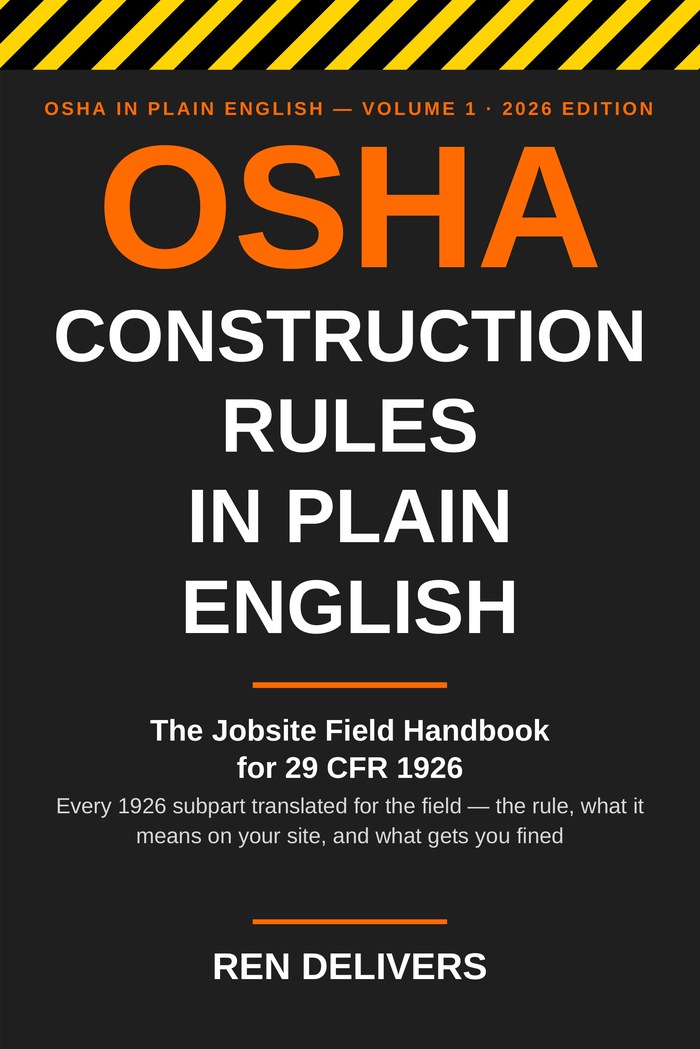
The full steel erection standard, translated: OSHA Construction Rules in Plain English
This page is the summary. The book is the whole code. OSHA Construction Rules in Plain English by Ren Delivers covers all of 29 CFR 1926 in 565 pages — the rule, what it means on your site, and what gets you fined — including the complete Subpart R steel erection standard at 1926.750–761, written for the trailer, not the law office.
Paperback — $34.95 on Amazon Kindle — $9.99 Both books — First Aid & OSHA
Common questions
Does 1926.761 require a certification card?
No paragraph in 1926.761 names a card or certificate. It requires training by a qualified person, a program the employer institutes, and ensured employee participation — plus the three special-training topics in (c).
Is fall hazard training only for connectors?
No. Paragraph (b) covers each employee exposed to a fall hazard. Connectors get that baseline plus the special connector training in (c)(2).
Can the CDZ crew skip special training if they did fall hazard training?
No. Paragraph (c) is in addition to (a) and (b). CDZ work, multiple-lift rigging, and connecting each carry their own special-training duty.
This page is a plain-language summary of the federal rules, not legal advice. State-plan states can have their own rules — check yours.