Short answer: Two sentences carry the whole steel-erection rule. Under 29 CFR 1926.759(a), all materials, equipment, and tools not in use while aloft must be secured against accidental displacement. Under 1926.759(b), the controlling contractor must bar other construction processes below steel erection — unless overhead protection is provided for the employees below.
This page completes the Subpart R set alongside our steel erection answer page and steel joists answer page. 1926.759 is short because it states outcomes; the companion general rules below supply the hardware dimensions.
Securing loose items aloft — the erector's duty: 1926.759(a)
Not in use means secured. The rule covers materials, equipment, and tools alike, and the trigger is simply being aloft and not in use — a wrench set down on a beam flange, a bolt bag left open, dunnage on a deck. Each must be secured so wind, vibration, or a kicked boot cannot displace it.
The standard names no device. Tethers, closed bolt bags and buckets, and securing loose material at the end of each task are all means to the same stated end. Loose items placed on top of metal decking bundles to be hoisted must likewise be secured to the bundles under the hoisting rules at 1926.753.
Work below — the controlling contractor's duty: 1926.759(b)
Barred by default. Paragraph (b) covers falling objects other than materials being hoisted, and it puts the duty on the controlling contractor — listed expressly among that contractor's Subpart R duties at 1926.750(c). Other construction processes do not run below steel erection unless overhead protection is provided for the employees below.
Two compliant postures: keep the other trades out from under active erection, or provide real overhead protection where they must be. A hard hat alone is not the overhead protection this paragraph describes — it is the last layer, under 1926.100, for areas where falling-object head injury is possible.
The general rule on every other job: 1926.501(c)
Outside steel erection, 1926.501(c) requires a hard hat for each exposed employee plus one of three measures: toeboards, screens, or guardrail systems that prevent objects from falling from higher levels; a canopy structure with potential fall objects kept far enough from the edge that they cannot fall if displaced; or a barricaded fall area that employees are prohibited from entering, again with objects kept back from the edge.
For the fall-protection triggers themselves, see our fall protection answer page; for the paperwork that tracks inspections, see the templates page.
Toeboards — the dimensions: 1926.502(j)
At least 3-1/2 inches high, no more than 1/4 inch clearance above the walking/working surface, solid or with openings no more than 1 inch, and able to withstand at least 50 pounds of force in any downward or outward direction. Where material is piled higher than the toeboard's top edge, paneling or screening runs from the surface or toeboard up to the guardrail's top rail or midrail.
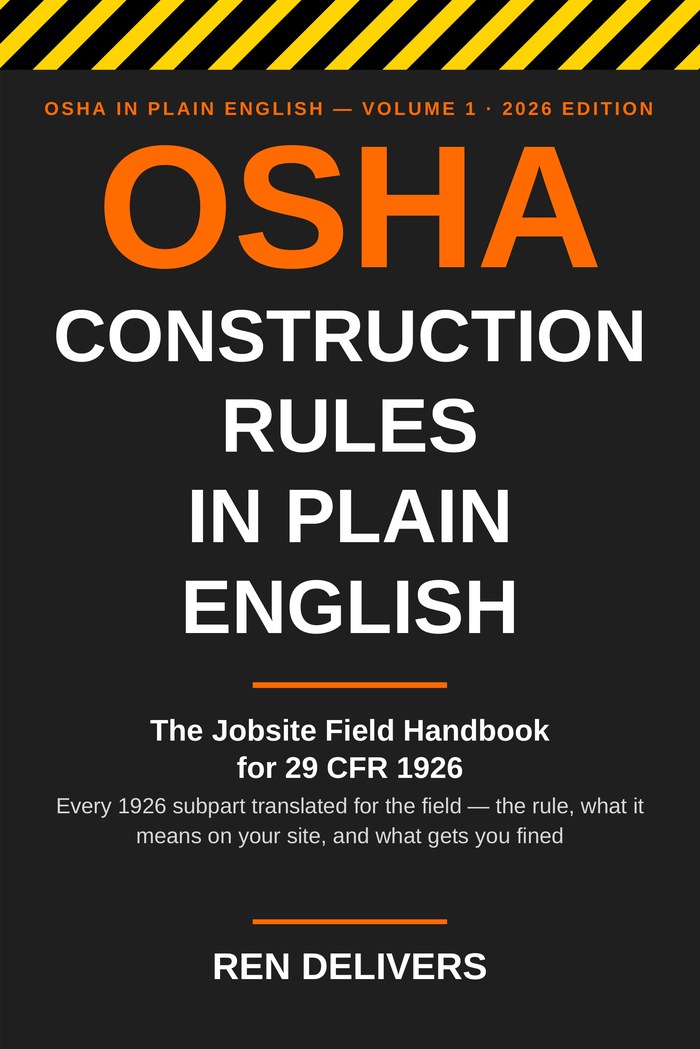
The full steel standard, translated: OSHA Construction Rules in Plain English
This page is the summary. The book is the whole code. OSHA Construction Rules in Plain English by Ren Delivers covers all of 29 CFR 1926 in 565 pages — the rule, what it means on your site, and what gets you fined — including the complete Subpart R steel erection standard at 1926.750–761, written for the trailer, not the law office.
Paperback — $34.95 on Amazon Kindle — $9.99 Both books — First Aid & OSHA
Common questions
Does 1926.759(b) cover the load on the crane?
No. Paragraph (b) is expressly about falling objects other than materials being hoisted. Hoisted loads are governed by the hoisting and rigging rules at 1926.753 — including securing loose items placed on top of decking bundles.
Can other trades work below if everyone wears a hard hat?
No. Under 1926.759(b) the controlling contractor must bar other processes below steel erection unless overhead protection is provided. Hard hats under 1926.100 are required where falling-object danger exists, but they do not substitute for the bar or the overhead protection.
Is a tool tether an OSHA requirement?
Not by name. The requirement is the outcome at 1926.759(a) — secured against accidental displacement. Tethering is one common way to meet it; ANSI/ISEA 121 is the voluntary standard for the tether equipment itself.
This page is a plain-language summary of the federal rules, not legal advice. State-plan states can have their own rules — check yours.