Short answer: Fifty micrograms. Under 29 CFR 1926.1153(d)(1), no construction worker may be exposed to respirable crystalline silica above 50 µg/m³ as an 8-hour time-weighted average. The action level is 25 µg/m³ — below that, under any foreseeable conditions, the standard does not apply. Between the two numbers, the standard's duties switch on: control the dust, assess the exposure, and train the crew.
Silica is the dust from concrete, block, stone, tile, and mortar. The respirable fraction is invisible in ordinary light, stays airborne, and scars lungs permanently — which is why this standard is built around controlling dust at the source with water and ventilation, not around respirators first.
Table 1: the compliance shortcut — 1926.1153(c)
Eighteen tasks, controls spelled out. Table 1 lists common tasks — stationary masonry saws, handheld power saws, walk-behind saws, drills, jackhammers and chipping tools, grinders, mixing and demolition, heavy equipment — and for each one names the engineering controls, work practices, and respiratory protection required, split at four hours per shift.
Fully and properly, or it doesn't count. Implement Table 1 exactly for a task and you do not have to sample the air for that task. Half-implement it — a saw with the water feed kinked off, a grinder with no shroud — and you are back to exposure assessment and the PEL for everything.
The written plan and the competent person — 1926.1153(e)
Written exposure control plan. The plan identifies the tasks where exposure can occur, the controls, work practices, and housekeeping measures used on each, and how access is restricted where respirators are required. Every employee must be able to access it.
Competent person. The plan identifies a competent person who can recognize silica hazards and who makes frequent, regular inspections of the jobsite, materials, and equipment. On multi-employer sites, the host employer must tell every other employer about the silica tasks, the controls, and its competent person before work starts.
Housekeeping: no dry sweeping — 1926.1153(h)
Wet it or vacuum it. Dry sweeping and dry brushing that could expose a worker are prohibited unless wet methods or a HEPA-filtered vacuum are not feasible. Blowing down with compressed air is only allowed when the nozzle captures the dust at the source or vents it so nobody else is exposed.
Respirators are the backstop, not the plan — 1926.1153(g). Where exposure exceeds the PEL, respirators are required under a full respiratory protection program. Table 1 itself assigns respirators to the dustiest tasks and longest shifts — read the row for your task before the shift, not after the citation.
Medical surveillance and training — 1926.1153(i) and (j)
Thirty respirator days. Medical surveillance is offered at no cost to every worker required to wear a respirator under the standard for 30 or more days a year — baseline within 30 days of assignment, then at least every three years, including a chest X-ray, lung-function test, and a tuberculosis test at the baseline exam.
Training. Every exposed worker must be able to explain what silica is, which tasks expose them, what the plan and controls are, and what the medical program offers — and that training repeats at least annually. Logging those talks is exactly what the paperwork on the templates page is for.
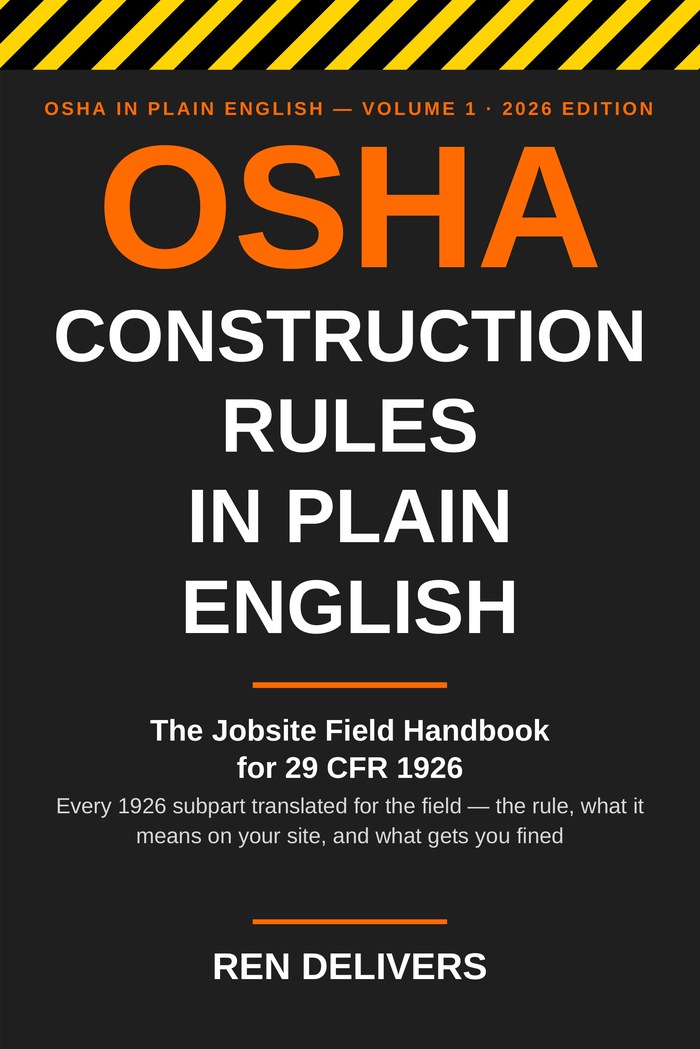
The full silica standard, translated: OSHA Construction Rules in Plain English
This page is the summary. The book is the whole code. OSHA Construction Rules in Plain English by Ren Delivers covers all of 29 CFR 1926 in 565 pages — the rule, what it means on your site, and what gets you fined — including the complete respirable crystalline silica standard at 1926.1153, written for the trailer, not the law office.
Paperback — $34.95 on Amazon Kindle — $9.99 Both books — First Aid & OSHA
Common questions
Does cutting one block in the open air really count?
If the task is on Table 1, yes — the row applies by task, not by how dusty the day feels. Use the listed control (usually integrated water delivery) and the respirator column for your shift length.
What if our task isn't on Table 1?
Then the employer must assess exposure for anyone who is, or may reasonably be expected to be, at or above the action level, keep exposure at or below the 50 µg/m³ PEL with engineering and work-practice controls, and add respirators where that is not enough.
Who pays for the medical exams?
The employer. Medical surveillance under 1926.1153(i) is made available at no cost to the employee, at a reasonable time and place.
This page is a plain-language summary of the federal rules, not legal advice. State-plan states can have their own rules — check yours.