Short answer: Ten feet. Under 29 CFR 1926.451(g)(1), every worker on a scaffold more than 10 feet above a lower level must be protected from falling — usually by guardrails, on some scaffold types by a personal fall arrest system, on a few by both. That 10-foot trigger is the single most-missed number in Subpart L, because the rest of construction fall protection starts at 6 feet. Scaffolds have their own subpart and their own trigger.
The rest of the job is just as mechanical: a platform that is fully planked, a foundation that will not settle, access that is not a crossbrace, and a competent person who actually inspects it before the shift.
Strength and footing: the 4x rule
Four times the load — 1926.451(a)(1). Each scaffold and component must support its own weight plus at least 4 times the maximum intended load without failure. Suspension ropes carry a higher bar: 6 times the maximum intended load under 1926.451(a)(3).
Footing. Supported scaffolds stand on base plates and mud sills or another firm foundation. Unstable objects — boxes, barrels, loose blocks — are never used to support a scaffold or a worker, and front legs are not spaced farther apart than the base allows for stability.
The platform: fully planked, no gaps
Fully planked — 1926.451(b)(1). Each platform is fully planked or decked between the front uprights and the guardrail supports, with gaps no wider than 1 inch except where a wider opening is genuinely necessary around uprights.
Width — 1926.451(b)(2). Platforms are at least 18 inches wide in most cases, with narrow exceptions for specific scaffold types. Scaffold planks are scaffold-grade or equivalent, and platforms are kept clear of debris that creates a tripping or falling-object hazard.
Falling objects. Where workers below can be hit, Subpart L calls for guardrails with toeboards, screens, or barricades — the platform rules protect the people underneath as well as the people on top.
Access: never the crossbraces
Access over 2 feet — 1926.451(e)(1). When a platform is more than 2 feet above or below the access point, workers use a ladder, stair tower, ramp, walkway, integral frame, or direct access from another surface. Crossbraces are never a means of access — that is one of the most common scaffold citations on any jobsite.
Guardrails. Guardrail systems on supported scaffolds are installed along all open sides and ends of the platform, with toprails, midrails, and posts built to the strength requirements of 1926.451(g)(4). The fall-protection system has to be in place before the platform is used, not added after the first course of work.
People: competent person, inspections, training
Inspect before every shift — 1926.451(f)(3). A competent person inspects scaffolds and components for visible defects before each work shift and after anything that could affect structural integrity — a storm, a forklift bump, a move.
Competent-person direction — 1926.451(f)(7). Scaffolds are erected, moved, dismantled, or altered only under the supervision and direction of a competent person qualified in scaffold erection, and only trained, experienced workers do that work.
Training — 1926.454. Every worker who works on a scaffold is trained by a qualified person to recognize its hazards — electrical, fall, and falling-object — and the controls for them. Workers who erect, dismantle, move, operate, repair, or inspect scaffolds get their own training, and retraining is required whenever a worker shows the first training did not take. Logging those talks is exactly what the paperwork on the templates page is for.
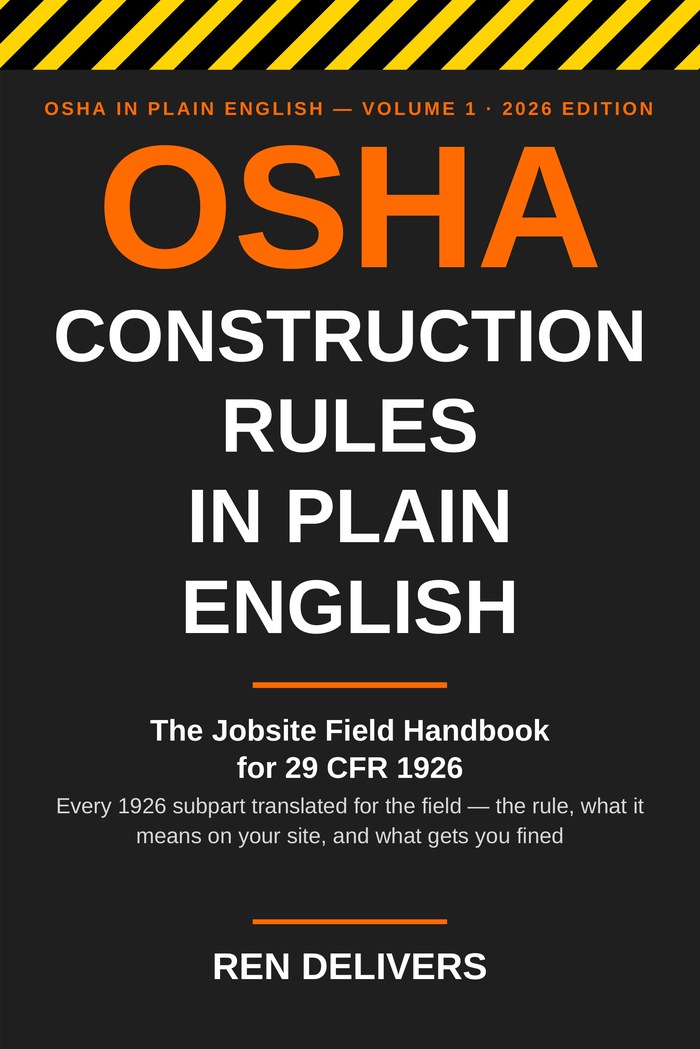
The full Subpart L, translated: OSHA Construction Rules in Plain English
This page is the summary. The book is the whole code. OSHA Construction Rules in Plain English by Ren Delivers covers all of 29 CFR 1926 in 565 pages — the rule, what it means on your site, and what gets you fined — including the complete scaffolds chapter in Subpart L, written for the trailer, not the law office.
Paperback — $34.95 on Amazon Kindle — $9.99 Both books — First Aid & OSHA
Common questions
Is the scaffold trigger 6 feet or 10 feet?
Ten feet on scaffolds — 1926.451(g)(1). The 6-foot trigger in 1926.501(b)(1) covers most other construction work. Mixing the two up is how crews end up unprotected at 8 feet on a scaffold, believing they are legal.
Can you climb the frame to get up?
Only integral prefabricated access frames built for climbing. Crossbraces are never access, and end frames not designed as ladders are not a legal way up either.
Can a scaffold be moved with workers on it?
Generally no. Surface scaffolds may only be moved horizontally with workers on them under the narrow conditions of 1926.451(f)(5)-(6) — a firm, level surface, outriggers and stability requirements met, and the competent person's go-ahead. When in doubt, everybody gets down.
This page is a plain-language summary of the federal rules, not legal advice. State-plan states can have their own rules — check yours.