Short answer: Stay calm and professional. Verify the compliance officer's credentials — OSHA needs your consent or an inspection warrant to enter, and most employers consent. Put one designated representative with the officer for the whole visit, call your safety lead and leadership right away, and stick to the scope agreed in the opening conference. Take your own notes and photos of everything the officer documents. Answer truthfully and briefly, never guess, and never falsify a record. After the closing conference, watch the mail: citations arrive by certified mail, and from the day you receive them you have 15 working days to pay, request an informal conference, or file a Notice of Contest.
Nobody plans their morning around an inspection. The crews that come out of one clean are not lucky — they are the ones whose paperwork, PPE, and housekeeping were already right, and who ran the visit instead of letting the visit run them.
The inspection, step by step
1. Credentials. The compliance officer presents official OSHA credentials. If they are not offered, politely ask to see them and write down the officer's name and office. Impostors are rare; verifying is still step one.
2. Opening conference. The officer explains why the site was selected — a complaint, a referral, a programmed inspection, or a reported injury — plus the scope and procedures. This is where scope gets set: a complaint about one area does not automatically mean a wall-to-wall tour, so listen carefully and take notes. An employer representative and an employee representative are entitled to join the walkaround.
3. The walkaround. The officer tours the areas within scope, observes work, takes photos and measurements, and may interview employees privately. Your representative should shadow the entire tour, photograph everything the officer photographs, and note every measurement and comment. Fix an obvious hazard the moment you see it — prompt abatement during the inspection is noticed and documented.
4. Worker interviews. Workers can be interviewed, including privately. You cannot coach them, punish honesty, or retaliate against anyone for talking to OSHA — Section 11(c) of the OSH Act protects that, and retaliation creates a second case on top of the first.
5. Closing conference. The officer discusses apparent violations, possible citations and penalties, and proposed abatement dates, and explains your rights and the contest process. Ask questions, clarify facts you believe are wrong, and provide documents that correct the record — but do not argue the officer out of the job. Nothing is final until the citation arrives in writing.
After they leave: the 15-working-day clock
Citations arrive by certified mail. Calendar the receipt date the day it lands — your 15 working days run from receipt, not from the inspection.
Post the citation. Each citation must be posted at or near the place of the violation, and it stays up until the violation is abated or for 3 working days, whichever is longer.
Your three options, all inside 15 working days: (1) pay the penalty and abate the violations by the dates set; (2) request an informal conference with the OSHA Area Director to discuss abatement, classification, or penalty — many citations are adjusted there; (3) file a written Notice of Contest disputing the citation, the penalty, or the abatement date, which sends the case to the Occupational Safety and Health Review Commission.
The trap: an informal conference does not pause the clock. If the 15 working days pass with no Notice of Contest filed, the citation becomes a final, unreviewable order — even if you were mid-conversation with the area office.
2026 penalty scale: up to $16,550 per serious violation and up to $165,514 per willful or repeated violation. That math is why the first hour matters.
What not to do
Do not block or delay the officer, do not lie, and do not guess — "I don't know, I will find out" is a complete answer. Do not volunteer areas, crews, or documents outside the agreed scope. Do not backdate, recreate, or "fix" training records, inspection logs, or toolbox-talk sheets after the visit is announced — falsified records convert a manageable citation into willful territory and possible criminal referral. Do not let five different people give the officer five different stories: one representative speaks for the company.
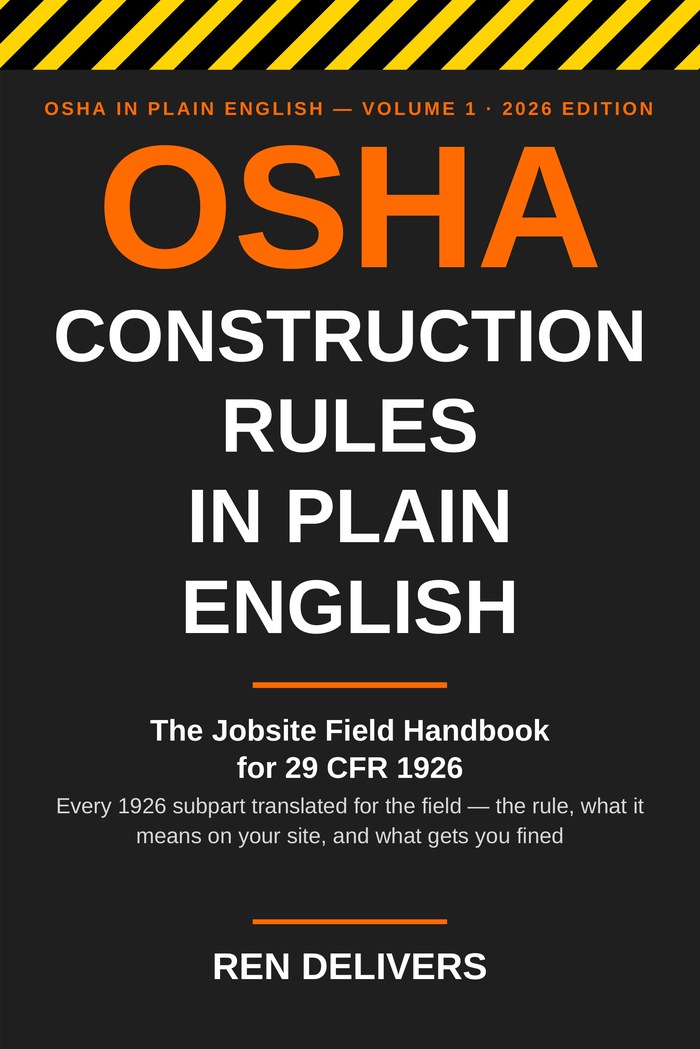
The playbook for this exact morning: OSHA Construction Rules in Plain English
This page is the summary. The book is the full playbook. OSHA Construction Rules in Plain English by Ren Delivers covers all of 29 CFR 1926 in 565 pages — the rule, what it means on your site, and what gets you fined — plus two jump-to playbook chapters written for this moment: "OSHA's On Site: The First Hour" and "Fighting Back: The Citation Playbook." It lives in the trailer so the first hour runs on a checklist, not on adrenaline.
Paperback — $34.95 on Amazon Kindle — $9.99 Both books — First Aid & OSHA
Common questions
Does OSHA have to show credentials?
Yes — the compliance officer presents official credentials at the start of the inspection. Ask politely if they are not offered, and record the officer's name.
Can OSHA interview workers without management present?
Yes. The officer may interview employees privately, and retaliating against a worker for participating is prohibited under Section 11(c) of the OSH Act.
Are citations issued during the visit?
No. The officer discusses apparent violations at the closing conference; the formal citation is issued afterward and sent by certified mail.
What if we fix a violation during the inspection?
Do it — prompt abatement is documented and viewed favorably, though it does not guarantee no citation for the condition that existed.
This page is a plain-language summary of the federal inspection process, not legal advice. State-plan states run their own programs with their own procedures — check yours.