Short answer: A construction jobsite needs first aid supplies that are easily accessible and matched to the hazards on that site, kept in a weatherproof container with individually sealed packages, and checked before the job and at least weekly under 29 CFR 1926.50(d). Stock bleeding control and wound care first — adhesive bandages, gauze pads including large pads, roller and triangular bandages, wound-cleaning wipes, adhesive tape, scissors, tweezers, and exam gloves — plus a resuscitation mask or airway, an emergency blanket, a splint, burn dressings, eye wash, and written emergency directions. The kit alone is not the whole requirement: the employer also has to make provisions for prompt medical attention before the project starts, provide a way to transport an injured person or contact an ambulance, and have a person with a valid first-aid certificate available at the worksite when a hospital, clinic, or physician is not reasonably accessible.
That is the floor. What your site actually needs rides on your hazards: heights, saws, concrete, electrical work, heat, and corrosive materials each add items. OSHA's Appendix A to 1926.50 is a non-mandatory guideline — the rule does not hand you one exact shopping list, it tells you to build the kit for your operation and keep it full.
What OSHA 1926.50 actually requires
Medical help lined up before work starts. 1926.50(a) requires the employer to ensure medical personnel are available for advice and consultation, and 1926.50(b) requires provisions to be made before the project begins for prompt medical attention in case of serious injury.
A trained person when help is not close. Under 1926.50(c), if there is no infirmary, clinic, hospital, or physician reasonably accessible in time and distance, a person with a valid first-aid training certificate — American Red Cross or equivalent verifiable training — must be available at the worksite.
Supplies, stored and checked. Under 1926.50(d)(1), first aid supplies must be easily accessible when required. Under 1926.50(d)(2), kit contents go in a weatherproof container with individual sealed packages for each type of item, and the employer checks the kit before it goes out on each job and at least weekly on each job to replace used items.
Transport and communication. 1926.50(e) requires proper equipment for prompt transportation of an injured person to a physician or hospital, or a communication system for contacting ambulance service. Where 911 is not available, the phone numbers of physicians, hospitals, or ambulances must be conspicuously posted.
Eyewash and drenching. Under 1926.50(g), where eyes or body may be exposed to injurious corrosive materials, suitable facilities for quick drenching or flushing of the eyes and body must be provided within the work area for immediate emergency use.
The practical jobsite list
Bleeding and wounds: adhesive bandages in assorted sizes, gauze pads (including large pads for serious bleeding), roller bandages, triangular bandages, adhesive tape, wound-cleaning wipes, scissors, and tweezers. Add a tourniquet and heavier bleeding-control dressings where saws, rebar, and steel work make a severe cut a real possibility — and train the crew to use them.
Breathing and CPR: a resuscitation mask or airway, exam gloves, and an AED on site or a known, fast route to one. A kit nobody is trained to use is a box, not a plan.
Bones, burns, and eyes: a splint, an emergency blanket, burn dressings, and sterile eye wash. Concrete, grinding, and battery work all put eyes at risk.
Heat: water, shade, and a way to cool a worker fast. Heat stroke is a kill-you emergency, and the first minutes are handled by the crew, not the ambulance.
The paperwork that saves minutes: written emergency directions in the kit, the site address posted where a caller can read it, and emergency numbers posted where 911 does not work. In an emergency, nobody should be guessing the address of the job.
One kit in the trailer is not enough for a big or multi-level site. Stage supplies near the active work, check them weekly, and restock the day something gets used — not the day somebody needs it again.
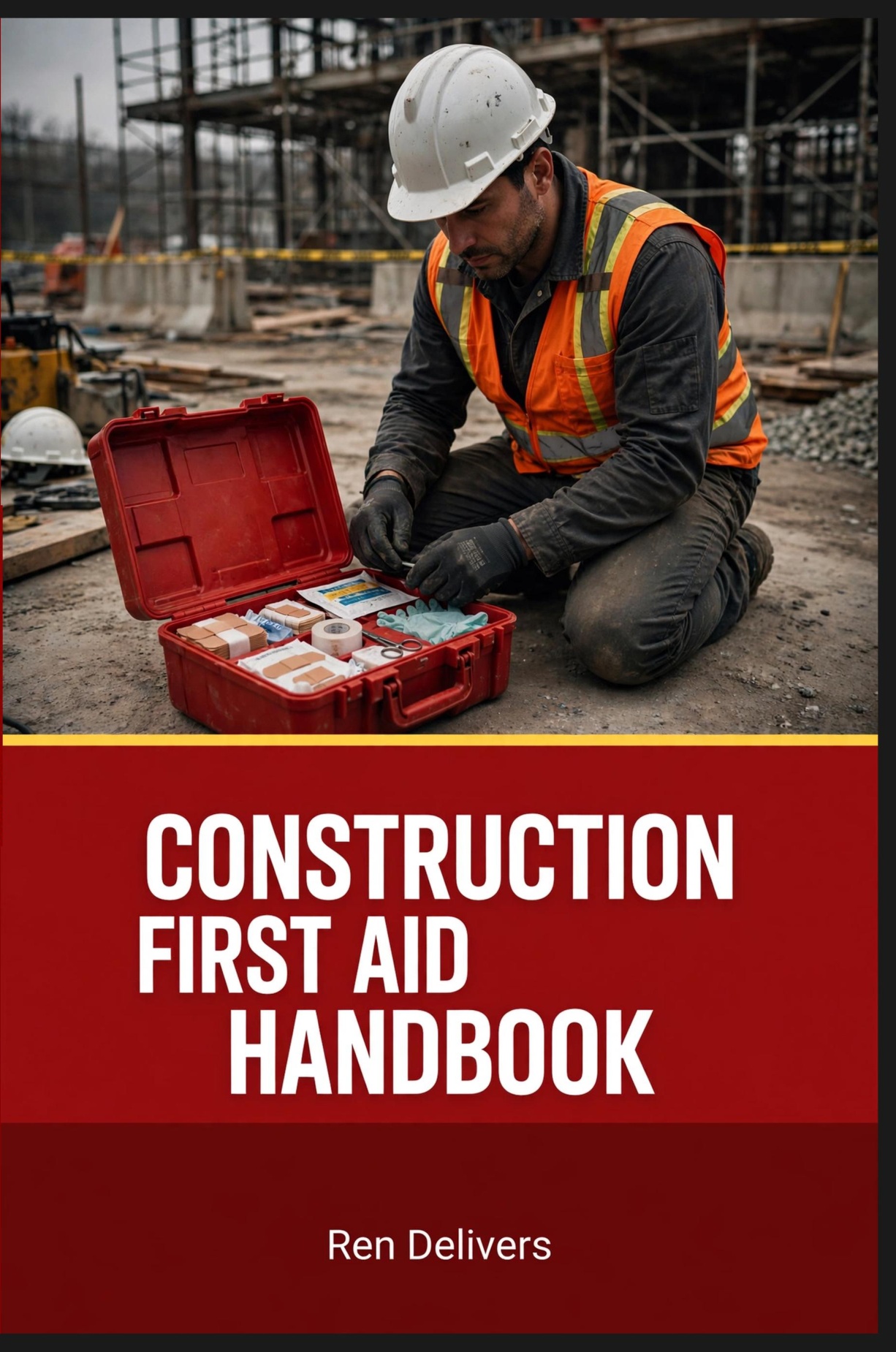
The book that lives in the gang box: Construction First Aid Handbook
Supplies buy you minutes. Knowing what to do with them is the other half. The Construction First Aid Handbook by Ren Delivers is a jobsite guide to keeping people alive until help arrives: bleeding control, CPR and AED, heat stroke, electrocution, and crush injuries, in jump-to playbook chapters a crew can flip straight to during an emergency. It was written by Brandon, a 30-year construction veteran, for the gang box — not the classroom.
Common questions
Does OSHA list the exact contents of a construction first aid kit?
No. 1926.50(d) requires supplies to be easily accessible and stored in a weatherproof container with sealed packages, checked weekly. Appendix A to 1926.50 is a non-mandatory guideline based on the ANSI minimum kit standard, and it tells employers to add supplies for larger operations and site-specific hazards.
How often does a jobsite first aid kit need to be checked?
Before it is sent out on each job and at least weekly on each job, so expended items are replaced — 29 CFR 1926.50(d)(2).
Does a jobsite need a trained first aid person?
Yes, when no clinic, hospital, or physician is reasonably accessible in time and distance: a person with a valid first-aid certificate must be available at the worksite under 1926.50(c).
Does a jobsite need an eyewash station?
Where eyes or body may be exposed to injurious corrosive materials, 1926.50(g) requires quick drenching or flushing facilities within the work area for immediate emergency use.
This page is a plain-language summary of the federal rules, not legal advice. State-plan states can have their own rules — check yours.