Short answer: Under 29 CFR 1926.651(l), walkways shall be provided wherever employees or equipment are required or permitted to cross over an excavation, and a walkway 6 feet or more above a lower level needs guardrails that comply with 1926.502(b). Getting out is just as specific: under 1926.651(c)(2), a trench 4 feet or more deep needs a stairway, ladder, ramp, or other safe egress placed so no employee travels more than 25 feet laterally to reach it. And under 1926.651(c)(1)(i), structural ramps are designed by a competent person — equipment ramps by a competent person qualified in structural design.
This page completes the Subpart P set alongside our trench safety answer page, excavation competent person answer page, underground utilities answer page, and excavation water answer page.
Crossing over — walkways: 1926.651(l)
Required or permitted means provided. Paragraph (l) is one sentence with two duties: walkways shall be provided where employees or equipment are required or permitted to cross over excavations — nobody balances across a plank that was never meant to be a crossing, and no machine straddles a trench on improvised timbers. The second duty is the guardrail trigger below.
Guardrails at 6 feet: 1926.651(l) + 1926.502(b)
Six feet up means railed. Paragraph (l) adds: guardrails which comply with 1926.502(b) shall be provided where walkways are 6 feet (1.8 m) or more above lower levels. That pulls in the full guardrail spec — top rail 42 inches plus or minus 3 inches, midrails, and the 200-pound top-rail strength requirement of the fall protection standard.
Getting out — the 25-foot rule: 1926.651(c)(2)
Four feet deep, 25 feet max. Paragraph (c)(2): a stairway, ladder, ramp or other safe means of egress shall be located in trench excavations that are 4 feet (1.22 m) or more in depth so as to require no more than 25 feet (7.62 m) of lateral travel for employees. In a cave-in there is no time to run the length of the trench — the way out has to already be within 25 feet of wherever the work is.
Ramps are designed, not improvised: 1926.651(c)(1)
Competent person designs them. Paragraph (c)(1)(i): structural ramps used solely by employees shall be designed by a competent person; ramps used for equipment access or egress shall be designed by a competent person qualified in structural design, and constructed in accordance with the design. The build details at (c)(1)(ii)–(v): members of multi-member ramps and runways connected together to prevent displacement; structural members of uniform thickness; connecting cleats attached to the bottom of the runway or otherwise arranged to prevent tripping; and ramps used in lieu of steps given cleats or other surface treatment on top to prevent slipping.
Paperwork that gets a contractor organized — including excavation inspection checklists — is on the templates page.
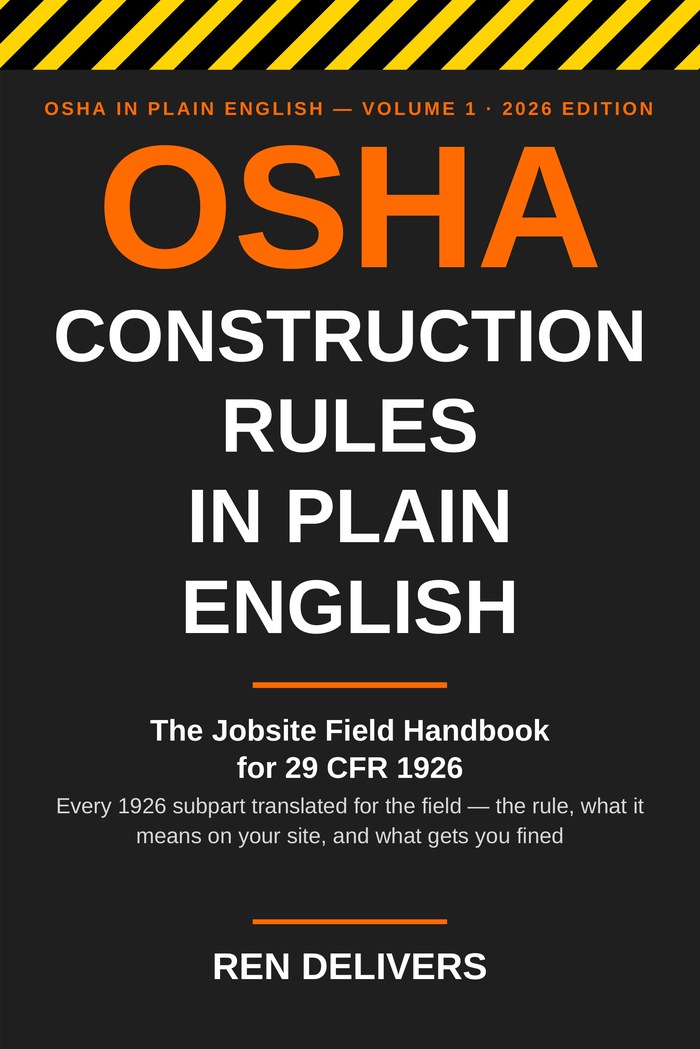
The full excavation standard, translated: OSHA Construction Rules in Plain English
This page is the summary. The book is the whole code. OSHA Construction Rules in Plain English by Ren Delivers covers all of 29 CFR 1926 in 565 pages — the rule, what it means on your site, and what gets you fined — including the complete Subpart P excavation standard at 1926.650–652, written for the trailer, not the law office.
Paperback — $34.95 on Amazon Kindle — $9.99 Both books — First Aid & OSHA
Common questions
Does the 25-foot rule apply to every excavation?
Paragraph (c)(2) states it for trench excavations 4 feet or more in depth. Wider excavations still need safe access and egress under (c)(1) — the 25-foot lateral-travel number is the trench rule.
Can a worker design the equipment ramp?
No. Paragraph (c)(1)(i) requires equipment ramps to be designed by a competent person qualified in structural design, and built in accordance with that design.
Does a low walkway need guardrails?
Paragraph (l) requires guardrails complying with 1926.502(b) where walkways are 6 feet or more above lower levels. Below that height the walkway itself is still required wherever crossing is required or permitted.
This page is a plain-language summary of the federal rules, not legal advice. State-plan states can have their own rules — check yours.