Short answer: At eight feet. Under 29 CFR 1926.706(b), every masonry wall over 8 feet high must be adequately braced to prevent overturning and collapse — unless the wall is already adequately supported so it will not overturn or collapse — and the bracing stays until the permanent supporting elements are in place. Before the wall even starts, 1926.706(a) requires a limited access zone equal to the wall height plus 4 feet on the unscaffolded side.
Subpart Q (29 CFR 1926.700–706) is OSHA's concrete and masonry standard. Its two big failure modes are the ones that kill people: formwork that gives way under wet concrete, and a green masonry wall that blows or tips over before it is tied into the structure. The rules below are built around those two moments.
The limited access zone — 1926.706(a)
Set it before you lay the first unit. The zone is established prior to the start of construction of the wall, on the side that will be unscaffolded, and runs the entire length of the wall.
Height plus four feet. A 12-foot wall means a 16-foot zone. Only employees actively engaged in constructing the wall may enter it — no other employees. It remains in place until the wall is adequately supported to prevent overturning and collapse; for a wall over eight feet, it remains until the bracing requirement in 1926.706(b) has been met.
Formwork: support every load you can anticipate — 1926.703(a)
Designed, fabricated, erected, supported, braced, maintained. Formwork must be capable of supporting without failure all vertical and lateral loads that may reasonably be anticipated — wet concrete is heavy, fast placement adds lateral pressure, and wind and equipment loads count.
Drawings on site. The drawings or plans, including all revisions, for the jack layout, formwork (including shoring equipment), working decks, and scaffolds must be available at the jobsite — not back at the office.
Shoring and reshoring — 1926.703(b)
Inspect three times around the pour. Shoring equipment is inspected prior to erection against the formwork drawings, and erected shoring is inspected immediately prior to, during, and immediately after concrete placement.
Damaged means out — or reinforced now. Equipment damaged so its strength is reduced must not be used for shoring; equipment found damaged or weakened after erection must be immediately reinforced. Sills must be sound, rigid, and capable of carrying the maximum intended load, and base plates, shore heads, extension devices, and adjustment screws must be in firm contact with the foundation and the form. Reshoring goes in as the original forms and shores come out, whenever the concrete must support loads beyond its current capacity.
Stripping forms: strength first — 1926.703(e)
Not on a schedule — on strength. Forms and shores (except slabs on grade and slip forms) stay in place until the employer determines the concrete has gained sufficient strength to support its own weight and superimposed loads. Reshoring stays until the concrete it supports has attained adequate strength for its weight and all loads in place on it.
Planning the pour is paperwork too. The estimate, schedule, and daily log for a concrete job are exactly what the templates page covers — price the shoring, bracing, and cure time in the bid, not as a surprise.
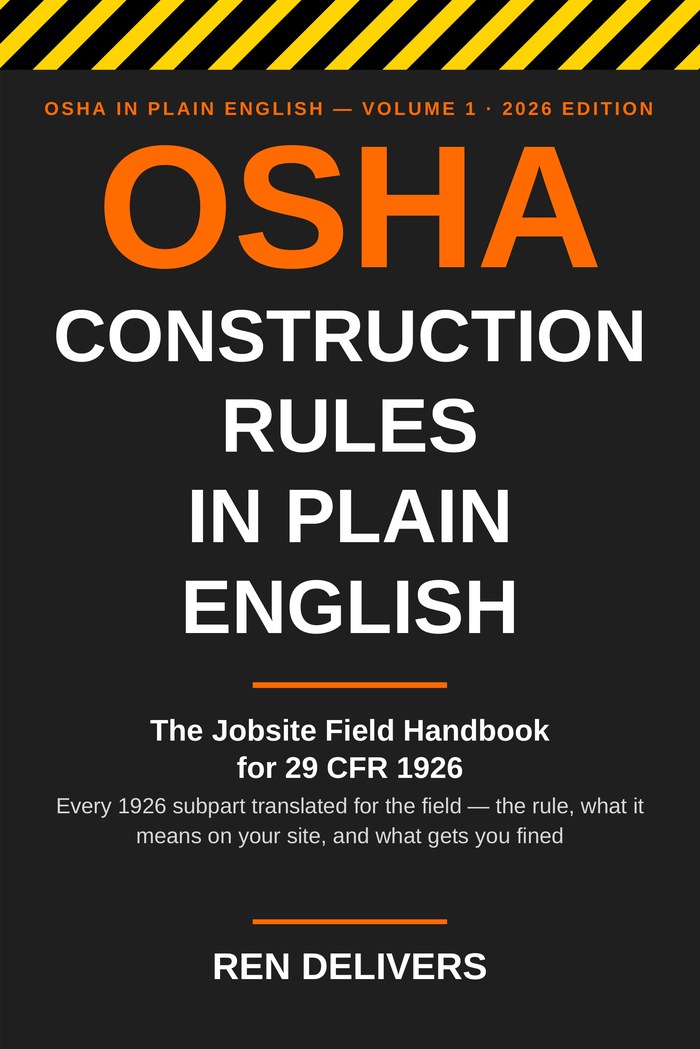
The full concrete and masonry standard, translated: OSHA Construction Rules in Plain English
This page is the summary. The book is the whole code. OSHA Construction Rules in Plain English by Ren Delivers covers all of 29 CFR 1926 in 565 pages — the rule, what it means on your site, and what gets you fined — including the complete Subpart Q concrete and masonry standard at 1926.700–706, written for the trailer, not the law office.
Paperback — $34.95 on Amazon Kindle — $9.99 Both books — First Aid & OSHA
Common questions
Does an 8-foot wall exactly need bracing?
The rule in 1926.706(b) covers walls over eight feet in height. At or under eight feet, the limited access zone still applies and still stays until the wall is adequately supported — and a wall that is not adequately supported can need support regardless of the number.
Can the limited access zone replace bracing on a tall wall?
No. For a wall over eight feet, the zone remains in place until the bracing requirement in 1926.706(b) has been met — the zone controls who is exposed, the bracing controls whether the wall falls.
Who decides when forms can be stripped?
The employer, under 1926.703(e)(1) — and the test is strength, not days on a calendar: the concrete must be able to support its weight and the superimposed loads placed on it.
This page is a plain-language summary of the federal rules, not legal advice. State-plan states can have their own rules — check yours.